One idea per frame
A frame is one screen of text. A car passes a board in two or three seconds and sees one frame, maybe two, so every frame has to stand on its own: one fact, no sentence. The Hornsby markets board is the model: MARKETS, then SUN 9-3, then an arrow. Nobody has to read it twice. We keep a cycle to three frames at most, two to three seconds each; a six-frame cycle means half the drivers never see the frame that mattered.
What fits on a frame
The boards we place have a 34-row LED matrix, and the font decides the line count. Large bold gives two lines of six characters; large standard, two lines of eight; medium, three lines of nine; the small fonts, four lines of eight or eleven. Our rule of thumb is two or three lines, eight characters a line, in the largest font that fits. If a word does not fit, find a shorter word rather than a smaller font: NOW OPEN, not OPENING TODAY; SUN 9-3, not SUNDAY MORNING.
The key fact first
Drivers need three things, in this order: what, when, where. What is the first frame or the top line: MARKETS, ROAD CLOSED, NOW OPEN. When is the next: SUN 9-3, 7PM-5AM, FROM MON 17 NOV. Where is the last: an arrow, NEXT LEFT, 300M. Numbers beat words every time, and the day-and-time line is the one people photograph. If a message needs a fourth fact, it needs a second board.
Colour, arrows and symbols
Five-colour boards show white, yellow, red, green and blue. Use colour to separate the fact from the time, not to decorate: white or yellow for the main line, green for times and hours, red for a warning such as ROAD CLOSED, blue for the arrow. The markets board is white, green and a blue arrow, and it reads from 200 m. Standard traffic arrows and symbols are built in. Nothing flashes, ever; it is one of the five placement rules, and councils ask for a flashing board to be switched off or taken away.
Roadworks and closures: the plan writes it
On a road reserve the traffic management plan sets the wording and the board position; we load it as written and place the board where the plan says. The usual shape is a warning days ahead (CHANGED TRAFFIC CONDITIONS over FROM MON 17 NOV), then the closure itself (ROAD CLOSED, 7PM-5AM, 12-16 NOV), then the direction (USE DETOUR with an arrow). A board that goes out three or four days before the closure is what the plan, the residents and the council expect; the night works page covers the rest of a closure.
Openings and events: you write it, we fit it
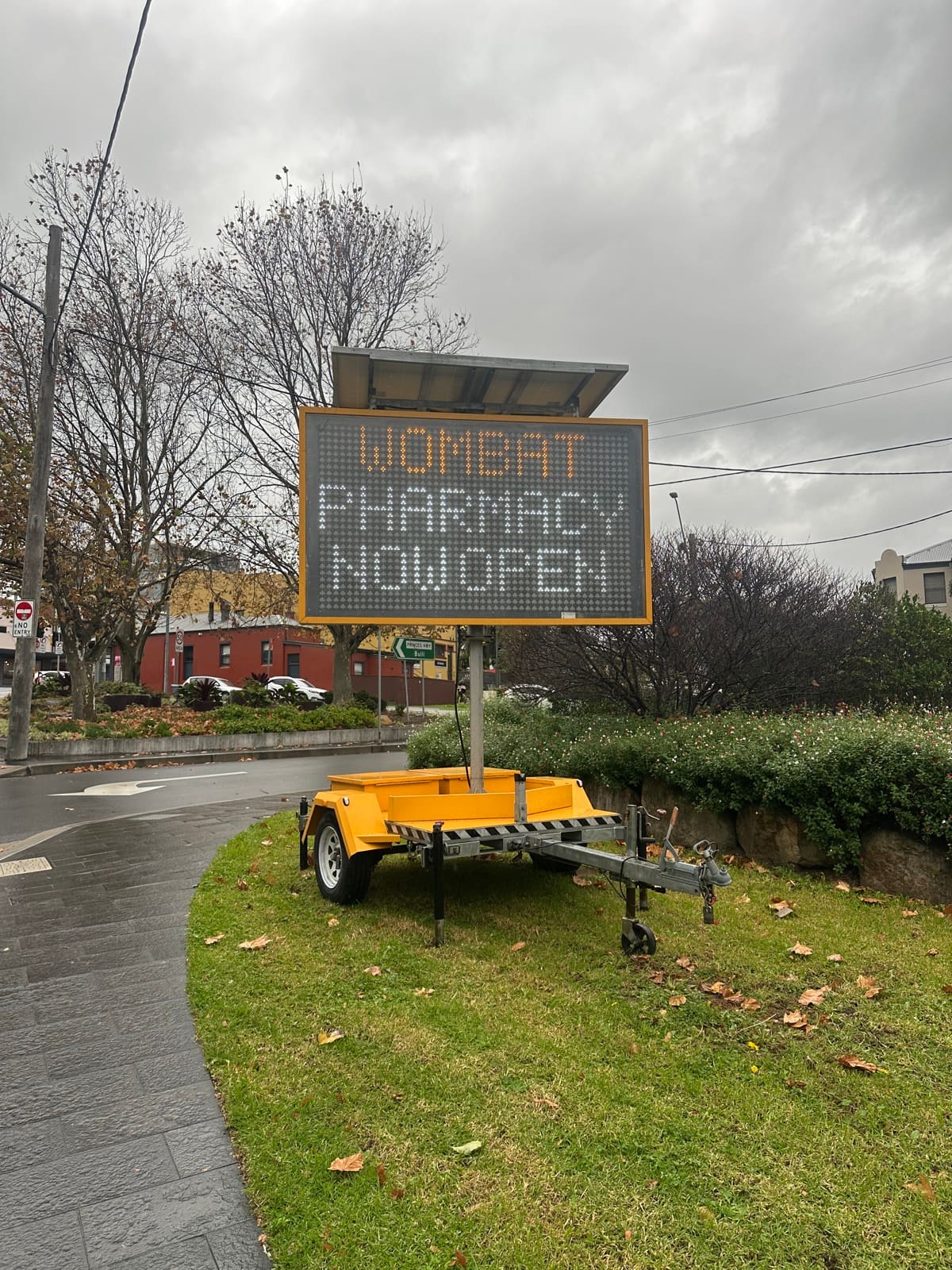
Three real boards. A pharmacy: WOMBAT, PHARMACY, NOW OPEN, three lines on one frame, in the pharmacy's own words. A gym opening countdown, repeated at about 50 sites: OPENING SOON, then the offer, then the date, one frame each, the same sequence every time. A monthly markets: MARKETS, SUN 9-3, arrow, loaded once in April and run every market weekend since. Send us the words as you would say them; we cut them to frames, size the font and send the program back for a tick before the board is delivered. The openings and events service is on its own page.
Schedules: let the board change by itself
A board can run a timetable, so the message changes by day or by hour without anyone visiting: a weekday message about parking, the markets message from Friday afternoon, TONIGHT from 4pm. Mid-hire changes are usually a phone call to us. Boards run on solar and a deep-cycle battery, so the schedule holds for the length of a normal hire as long as the panel sits in sun.
What to send us
- The words, frame by frame, in the order they should play
- Any arrow and which way it points
- Times or days the message should change, if it should
- The road, the dates and the nearest cross street